Updated November 3, 2026
Kruja matters because it was the heart of Skanderbeg's resistance to the Ottoman Empire. He took its castle on 28 November 1443 and raised the Albanian flag the same day, and the fortress then withstood three Ottoman sieges, in 1450, 1466 to 1467 and 1467. It finally fell on 16 June 1478, ten years after his death.
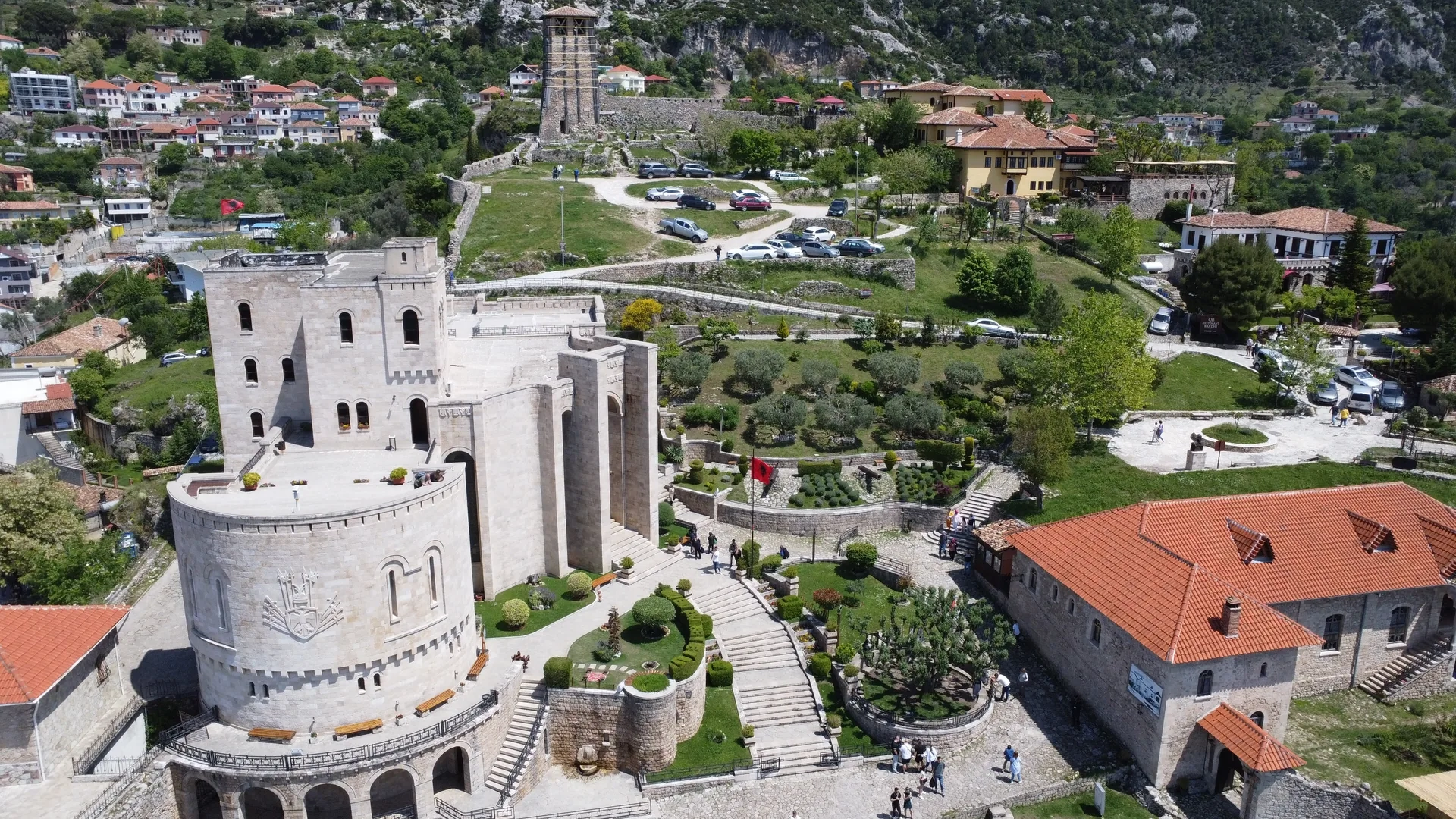
That story is still readable on the ground: a castle on a ridge, a national museum devoted to Skanderbeg, an ethnographic museum and a bazaar lane that leads up to the gate. Here are the dates, the sieges and the places, with notes on where historians disagree.
Before Skanderbeg: a fortress with a long memory
The castle on the ridge above Kruja is described as dating from the 5th or 6th century. Byzantine documents of the early 9th century already name the settlement, as Kroai, and the Albanian name is linked to kroi, a spring or fountain.
In 1190 Kruja became the capital of the Principality of Arbanon, founded by the archon Progon and usually described as the first Albanian state of the Middle Ages. Nearby lies Zgërdhesh, an Iron Age Illyrian site just south of the Fushë-Krujë to Kruja road. Scholars have placed the ancient settlement of Albanopolis at Zgërdhesh or at Kruja itself, and some archaeologists dispute the Zgërdhesh identification.
By 1395 the town had come under Ottoman vassalage. In the early 15th century Niketa Thopia captured it, and the Ottomans regained control in 1415.
1443: Skanderbeg takes Kruja
Gjergj Kastrioti, called Skanderbeg, was born around 1405 (the exact birth year and place are still debated). He was a hostage at the Ottoman court as a boy, rose in the sultan's service and became governor of Dibra in 1440. In 1443, during the Battle of Niš, he deserted the Ottoman army.
On 28 November 1443 he took Kruja by deceiving its Ottoman commander with a forged letter from the sultan, and raised the Albanian flag over the walls the same day. On 2 March 1444 Albanian nobles met at Lezhë and formed the League of Lezhë, with Skanderbeg as its chief.
Three sieges that failed
Historians give very different figures for the size of the armies, so the table keeps to dates and outcomes.
| Siege | Ottoman leadership | Dates | Outcome |
|---|---|---|---|
| First siege, 1450 | Sultan Murad II, with the future Mehmed II | 14 May to 26 October 1450 | Murad lifted the siege as winter approached |
| Second siege, 1466 to 1467 | Mehmed II led the campaign into Albania; Ballaban Badera commanded the siege after Mehmed withdrew in June 1466 | June 1466 to 23 April 1467 | Ottoman army defeated and Ballaban killed; Skanderbeg entered Kruja |
| Mehmed's campaign, 1467 | Sultan Mehmed II in person | Summer 1467, a few days at Kruja | He judged a direct assault impractical and withdrew |
Skanderbeg dies, Kruja falls
Skanderbeg died at Lezhë on 17 January 1468, around the age of 62, and was buried there. Kruja held on without him for another decade. The Ottomans blockaded the fortress through 1477 and 1478, a Venetian and Albanian relief army was defeated in September 1477, and after famine the garrison negotiated its surrender. Kruja was taken on 16 June 1478. Accounts of what happened to the defenders afterwards differ.
Under Ottoman rule the town was known as Akçahisar.
What you can still see
The castle. Kruja sits at about 600 m above sea level. You can walk the castle grounds and walls for free; the two museums inside charge separate fees, and our guide to castle opening hours and entrance fees has the details.
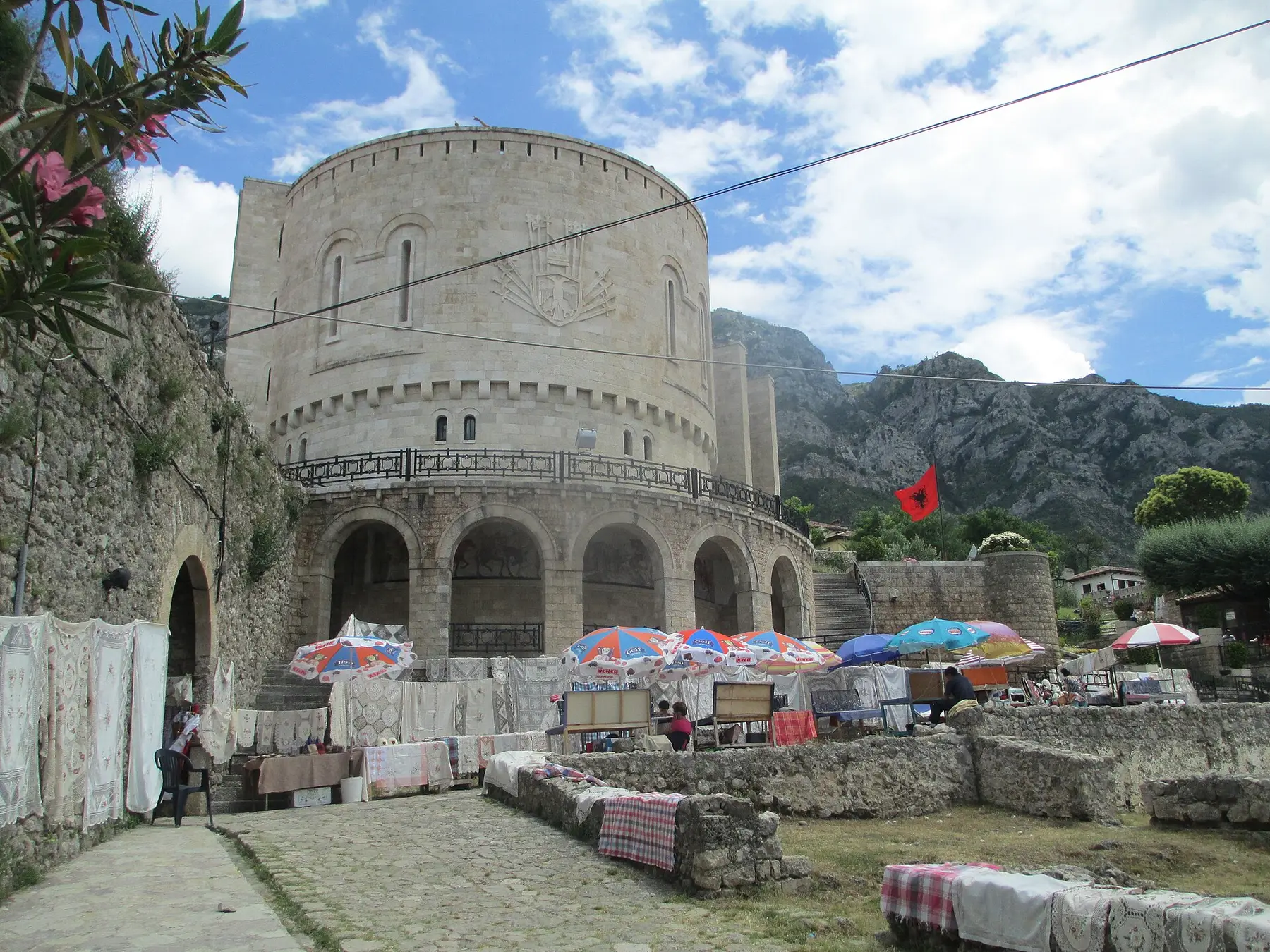
The Skanderbeg Museum. It opened on 1 November 1982 beside the castle and holds objects from Skanderbeg's time, including a replica of his goat-head helmet. The original is in the Kunsthistorisches Museum in Vienna.
The Ethnographic Museum. It opened to the public on 20 November 1989 and shows crafts and household objects.
The Old Bazaar. The Kruja municipality describes a characteristic bazaar that peaked in the 19th and 20th centuries, when about 130 shops traded here against about 70 today, known for copper, wool, silver and cap-making. A cobbled lane of workshops still runs up to the castle gate.
Why Kruja matters to Albanian identity
Skanderbeg's coat of arms, a black double-headed eagle on a red field, became the flag of the League of Lezhë. Albania's coat of arms is based on his symbols, and the national flag, adopted in 1912, shows the same eagle on red. Skanderbeg is Albania's national hero, and Kruja is the place where his story is told: in the museum, on the walls and in the street below the gate.
See it with a local historian
Kruja is about 20 km and 30 minutes from Tirana International Airport. Our Kruje Castle, Old Bazaar & Hidden Paths Tour takes 1h 15min – 2h 45min: the bazaar, the Skanderbeg Museum, the Ethnographic Museum and the castle, with a break. Our guides were born and raised in Kruja.
Arriving by air?
A private transfer from Tirana Airport to Kruja is €25 per car, about 30 minutes, fixed and agreed in advance. Send us your flight number on WhatsApp.
Walk the walls with a guide
The Kruje Castle, Old Bazaar & Hidden Paths Tour takes 1h 15min – 2h 45min and costs €20 per person, with a maximum of 8 people. Guided in English, Italian or French.
Keep reading
Plan your day with our castle tickets and hours guide, see the Kruja Castle page, or read how to get there in Kruja, Tirana and the airport. All options are listed under tours.
Kruja history: common questions
Why is Kruja important in Albanian history?
Kruja was the centre of Skanderbeg's resistance to the Ottoman Empire. He took the castle on 28 November 1443 and raised the Albanian flag there. The fortress withstood Ottoman sieges in 1450, 1466 to 1467 and 1467, and fell only in 1478, ten years after his death.
Who was Skanderbeg and what did he do in Kruja?
Gjergj Kastrioti, known as Skanderbeg, was an Albanian nobleman raised at the Ottoman court who changed sides in 1443. He recaptured Kruja on 28 November 1443, was chosen chief of the League of Lezhë in March 1444, and led the resistance until his death on 17 January 1468.
How many times was Kruja besieged by the Ottomans?
The best-known sieges are 1450 (Sultan Murad II), 1466 to 1467 (commanded by Ballaban Badera after Mehmed II withdrew) and 1467 (Mehmed II in person), all of which failed. A fourth blockade in 1477 and 1478 ended with the fortress surrendering on 16 June 1478.
When did Kruja fall to the Ottomans?
On 16 June 1478, after a blockade that began in 1477 and left the garrison starving. That was about ten years after Skanderbeg's death.
What is there to see in Kruja today?
The castle on the ridge, the Skanderbeg Museum (opened 1982), the Ethnographic Museum (opened 1989) and the Old Bazaar below the castle gate. The castle grounds and bazaar are free to walk; the museums charge separate fees.
How long do you need to see Kruja's history?
About three to four hours covers the castle, both museums and the bazaar at an unhurried pace. Our guided Kruje Castle, Old Bazaar & Hidden Paths Tour takes 1h 15min – 2h 45min.