Updated November 10, 2026
Mother Teresa (Nënë Tereza) was born Anjezë Gonxhe Bojaxhiu on 26 August 1910 in Skopje, then in the Ottoman Empire and now the capital of North Macedonia, into a Catholic family of Albanian descent. She left home in 1928, went on to live in India, founded the Missionaries of Charity in 1950 and won the Nobel Peace Prize in 1979. She died in Calcutta on 5 September 1997 and was canonised on 4 September 2016. In Albania, Tirana International Airport carries her name, and 5 September is a public holiday.
She was not from Kruja, and we found no source that places her in the town. The link with Kruja is the airport: Tirana International Airport carries her name and is about 30 minutes' drive from the town. Below are her dates, the places in Albania tied to her, how her family's roots are described, and where the sources disagree.
Her life in dates
These dates come from the Nobel Prize website, the Vatican's biography and the Missionaries of Charity's own page.
| Date | What happened |
|---|---|
| 26 August 1910 | Born in Skopje. She was baptised the next day and later regarded 27 August as her true birthday. |
| September 1928 | Leaves home at 18 to join the Sisters of Loreto in Ireland. |
| 6 January 1929 | Arrives in Calcutta, having left for India in December 1928. |
| 1931 to 1948 | Teaches at St. Mary's school in Calcutta. In 1946 she hears what she describes as a second call, on a train journey, and in 1948 she is allowed to leave the convent school to work among the poor. |
| 7 October 1950 | The Missionaries of Charity is established in the Archdiocese of Calcutta, with the Holy See's permission. |
| 1979 | Nobel Peace Prize, 'for her work for bringing help to suffering humanity'. Her Nobel lecture is dated 11 December 1979. |
| 5 September 1997 | Dies in Calcutta. India gives her a state funeral. |
| 19 October 2003 | Beatified by Pope John Paul II. |
| 4 September 2016 | Canonised by Pope Francis in St Peter's Square. |
Where to find her in Albania
Everything below is in Tirana or at the airport. None of it is in Kruja. The Albanian Tourism Agency publishes a short 'spiritual tour' of her family's Tirana sites, and most of the details come from it, with AFP and the Tirana Times. It gives no opening hours or street numbers, so check locally before you go.
| Place | What to know |
|---|---|
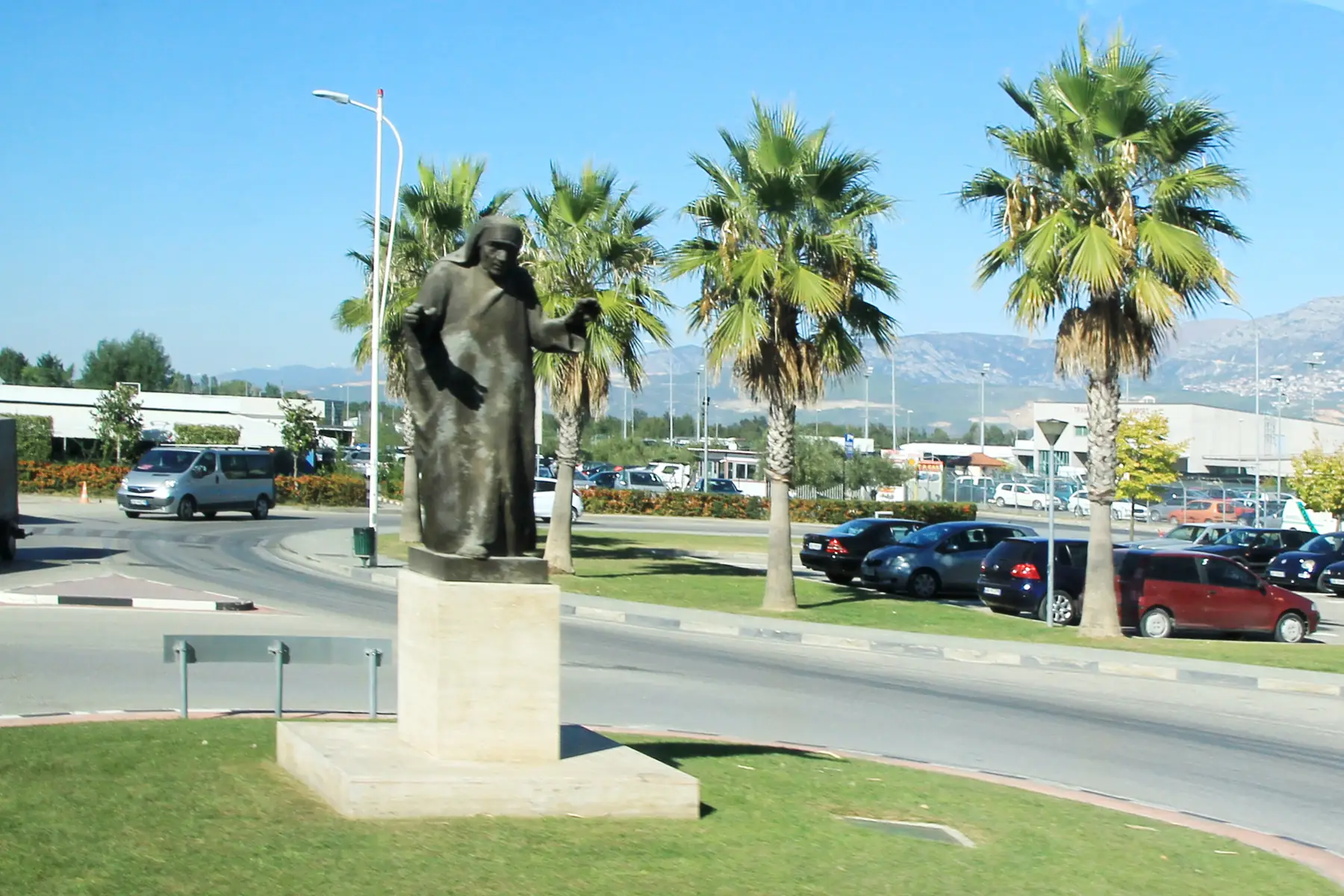
| Tirana International Airport Nënë Tereza | The airport carries her name. A photograph from September 2018 shows a statue of her on a roundabout in front of the terminal. The Tirana Times reported in 2008 that a 6-metre bronze statue had been set up at the airport in 2007, and the airport announced the dedication of a new artwork in her honour on 25 April 2023. We have not checked what stands there today. |
| Mother Teresa Pavilion, National Historical Museum | A pavilion about her life and work, with photographs of her with world figures and some of her belongings. She visited the museum twice, in 1989 and 1991. The museum announced that it would be closed to visitors from 15 March 2024 to 15 March 2028, so check its status before you plan around it. |
| The house on Kavaja Street | Where her mother and sister lived in Tirana, close to the Catholic church. The agency says it was the first house she visited in 1989. AFP reported in 2016 that a member of the family who sheltered her mother and sister still lived there, so treat it as a private home. |
| Sharra Cemetery | The agency gives this as the place where her mother and sister are buried. It does not say where in the cemetery. |
| Mother Teresa Square | The agency calls it the second-largest public square in Tirana. |
Her Albanian family, and where the sources differ
Her given name is Albanian. Anjezë is a form of Agnes, and gonxhe means 'flower bud'. She was the youngest child of Nikollë and Dranafile (Drane) Bojaxhiu. According to the Vatican, her father died suddenly when she was about eight, which left the family short of money.
Sources describe the family's origins in different ways. The Nobel Prize biography says only that her family was of Albanian descent. English Wikipedia says her father was born in Prizren, now in Kosovo, into a family from Mirdita in present-day Albania, and that her mother may have come from a village near Gjakova. AFP reported in 2016 that her mother was an ethnic Albanian whose family came from Kosovo, and that her father's roots are more debated: most people, especially in Albania, say he was also ethnically Albanian, while some Macedonians have argued that he was a Vlach, another Balkan ethnic group.
Her nationality is also described in layers. She was born in the Ottoman Empire and took Indian citizenship, which AFP dates to 1951. The Missionaries of Charity's page quotes her as saying: 'By blood and origin I am all Albanian. My citizenship is Indian. I am a Catholic nun.' Other sources word the quotation slightly differently. AFP adds that she was quoted describing herself both as a 'Skopjanka', a woman of Skopje, and as Albanian 'by blood', while insisting that she belonged to the world.
In the 1930s her mother and sister moved to Tirana. AFP reports that the communist leader Enver Hoxha barred her from visiting them. Both women died during Hoxha's rule, and she did not see either of them again.
Her work and the Nobel Prize
After her first vows in 1931 she taught in Calcutta until 1948. The Nobel biography says the suffering she saw outside the convent walls made such a deep impression that she asked to leave and work among the poorest in the slums. She had no funds and started an open-air school for slum children, and volunteers soon joined her. The order she founded in 1950 had as its main task to care for people nobody else was prepared to look after, and a decree of Pope Paul VI made it an international religious family in 1965.
The Norwegian Nobel Committee gave her the 1979 Peace Prize for bringing help to suffering humanity. Its press release highlighted her respect for the individual's dignity and noted that she had enlisted helpers from other religious denominations in Calcutta.
Her work has also drawn public criticism. The Nobel Prize website's fact page notes allegations that dying people in her hospices were refused pain relief while she accepted hospital treatment herself. According to Wikipedia, her authorised biographer, Navin Chawla, has answered that she never meant to build hospitals but a place where people refused admission elsewhere could die with comfort and some dignity.
Her visits to Albania
AFP counts three trips to Albania. The first was in 1989, when she visited the graves of her family and the house where they had lived. In December 1990 she met Nexhmije Hoxha on 3 December and President Ramiz Alia on 4 December to ask that the Missionaries of Charity be allowed to work in Albania, according to the National Catholic Register, which says the order began work there in March 1991. The Albanian Tourism Agency records museum visits in 1989 and 1991.
Some reference works give 1991 as the year she first returned. The Albanian Tourism Agency and AFP both date her first visit to 1989, so we use that.
What her name means in Albania today
Albania's Law no. 1/2018, published in the Official Gazette on 12 February 2018, added 5 September as a public holiday for her, replacing 19 October, the anniversary of her beatification. Some reference works still show the old date. Beyond the airport, the hospital and the square, AFP notes that both Albania and North Macedonia have statues, roads and hospitals in her name.
The question of who she belongs to is open in public. The Albanian historian Moikom Zeqo told AFP that she was born in Skopje but never declared herself Macedonian, and that she always spoke about her Albanian origins and her universal mission. The writer Ismail Kadare told AFP that illustrious people belong to all humanity but also have origins and a nation to which they are linked by blood. A Macedonian official quoted by AFP says Macedonians call her 'Skopjanka', and the director of the Skopje memorial house said nationality meant little to Teresa and that she would be unhappy to see the debate. In 2009 Albania asked India to hand over her remains, and India refused, saying she was 'resting in her own country, her own land'.
Albanian history beyond her story
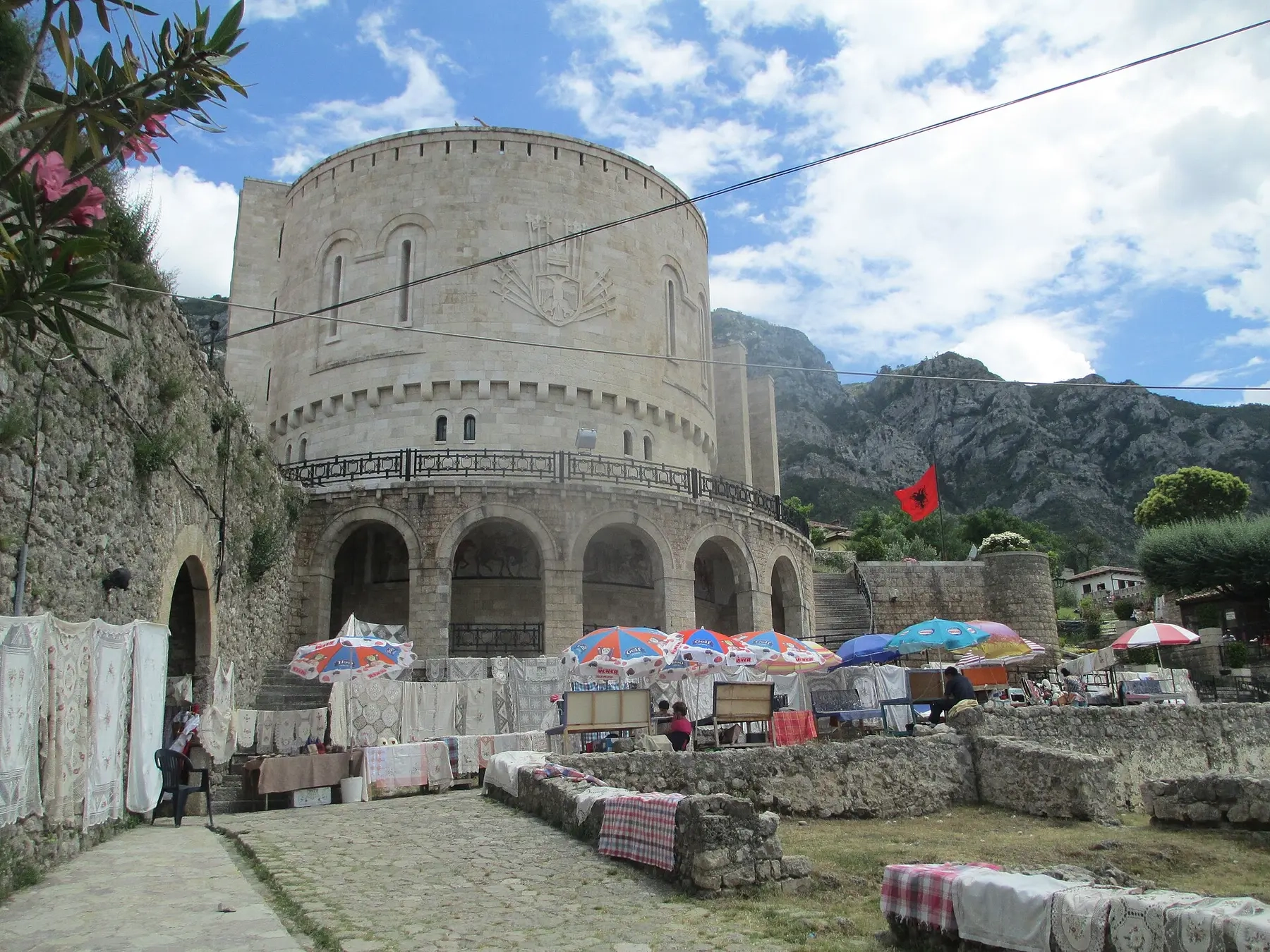
Albanian identity also rests on events of the 15th century. Gjergj Kastrioti, called Skanderbeg, took Kruja Castle on 28 November 1443 and raised the Albanian flag over its walls the same day. His black double-headed eagle on a red field is the eagle on the national flag adopted in 1912. Kruja is about 30 minutes from the terminal that carries Mother Teresa's name, and it is where Skanderbeg's story is told, in the castle, the Skanderbeg Museum and the Old Bazaar.
Landing at the airport that carries her name?
A private transfer from Tirana Airport to Kruja is €25 per car, about 30 minutes, fixed and agreed in advance. Send us your flight number on WhatsApp.
Albanian history beyond her story
The Kruje Castle, Old Bazaar & Hidden Paths Tour takes 1h 15min – 2h 45min and costs €20 per person, with a maximum of 8 people. Guided in English, Italian or French.
Keep reading
For Albanian history on the ground, read why Kruja matters in Albanian history and see the Kruja Castle page. Arriving or leaving by air? See getting between Kruja, Tirana and the airport and the layover guide. Where the airport that carries her name actually stands is explained in is Tirana airport in Tirana or in Kruja? All options are listed under tours.
Mother Teresa and Albania: common questions
Was Mother Teresa Albanian?
Her family was of Albanian descent, according to the Nobel Prize biography, and she described herself as Albanian by blood and Indian by citizenship. She was born in Skopje, then in the Ottoman Empire. Sources differ on details of her parents' origins, and Albania, North Macedonia and Kosovo each claim a connection to her.
Where and when was Mother Teresa born?
In Skopje, now the capital of North Macedonia, on 26 August 1910, when the city was part of the Ottoman Empire. She was baptised the next day as Anjezë Gonxhe (Agnes Gonxha) Bojaxhiu.
Is Tirana airport named after Mother Teresa?
Yes. Its full name is Tirana International Airport Nënë Tereza. Sources we found give 2001 or 2002 for the naming and none names the body that decided it, but the name was already in use when the current operator took over on 23 April 2005. The airport is about 30 minutes' drive from Kruja.
When was Mother Teresa canonised, and when is her holiday in Albania?
Pope Francis canonised her on 4 September 2016, after Pope John Paul II beatified her on 19 October 2003. Since a 2018 law, 5 September is a public holiday in Albania in her honour, replacing the earlier 19 October holiday.
Did Mother Teresa ever visit Albania?
Yes. AFP counts three trips, the first in 1989, after Enver Hoxha's death. She visited her family's graves and the house in Tirana where her mother and sister had lived. In December 1990 she met Albanian leaders to ask that her order be allowed to work there.
What can I see in Albania that is linked to Mother Teresa?
In Tirana: the Mother Teresa Pavilion at the National Historical Museum (announced closed from 15 March 2024 to 15 March 2028), the Kavaja Street house where her mother and sister lived, Mother Teresa Square and Sharra Cemetery, where her mother and sister are buried. At the airport, sources report a statue and a 2023 artwork in her honour. Check opening details and what is on site locally.
Is Mother Teresa linked to Kruja?
We found no source that places her in Kruja. The link is the airport that carries her name, about 30 minutes from the town. For Albanian history in Kruja itself, the story is Skanderbeg's: he took the castle on 28 November 1443.