Updated November 10, 2026
The qeleshe, called plis in Kosovo, is Albania's white felt cap: brimless, made from wool that is pressed into felt and shaped on a wooden mould. A professor of ethnology at the University of Prishtina calls it "a symbol of Albanian national identity". The news agency ATA reported on 28 February 2026 that Albania's National Council of Intangible Cultural Heritage had recognised the craft of making it as a national heritage value.
The Kruja municipality lists cap-making among the old trades of its bazaar, and a visitor account published in 2024 describes a family workshop there. Below: what to call the cap, what is and is not known about its origins, how it is made, the sulfur step makers describe, the families who keep the craft going and how to see it in Kruja. Where a fact comes from one person or one family, we say so.
What a qeleshe is and what to call it
A qeleshe is a white, brimless cap made from a single piece of wool felt, moulded to the shape of the head. Wikipedia's article on the cap says the name comes from lesh, the Albanian word for wool. In Albania the usual word is qeleshe and in Kosovo it is plis, according to Prishtina Insight's 2016 article, where the ethnologist Bashkim Lajci adds that other synonyms exist. Wikipedia also lists qylaf.
The origin of the word plis is open. Vladimir Orel's Albanian etymological dictionary links it to Greek pilos, "felt", and to related Latin and Germanic words, and Michael Driessen has argued that Orel's reconstruction is incorrect.
The height and shape change with the region. This is how the sources we read describe it.
| Area | Shape | Source |
|---|---|---|
| Northern highlands | Hemispherical | Wikipedia |
| Kukës | Truncated | Wikipedia |
| Mat, Mirditë and Dibër | Flat | Bashkim Lajci, Prishtina Insight |
| Tirana, Durrës and Kavajë | Tall | Bashkim Lajci, Prishtina Insight |
| Southern Albania, especially Gjirokastër and Vlorë | Taller than in the north, sometimes with a small protrusion; the Myzeqe plains are the exception | Wikipedia |
| Rest of northern Albania and Kosovo | Round, worn with tirq, traditional men's trousers | Bashkim Lajci, Prishtina Insight |
Where it comes from: the Illyrian claim
Several published accounts trace the cap to the Illyrians, the peoples of the western Balkans in antiquity. Wikipedia's article, citing Aleksandar Stipčević's The Illyrians (1977) and Gabriella Schubert (1993), says hemispherical caps of the Iron Age have been found in Illyrian graves, that a monument from Zenica in Bosnia shows a cap very like the qeleshe, and that monuments of the 2nd and 3rd centuries AD from Bosnia show Illyrians under Roman rule in similar caps. Lajci makes a similar case in Prishtina Insight, and Euronews describes the style as thought to date back to Illyrian culture, around 1000 B.C.
These accounts compare shapes in graves and carvings with the modern cap. None of the sources we read documents an unbroken line of caps from antiquity to today, so we give the Illyrian origin as the view of the authors cited, not as a settled fact.
The dated references to the Albanian cap itself are later. Wikipedia's article lists a 1542 Latin dictionary entry that describes an Albanian hat as tall and cone-shaped. It gives a 1596 depiction of Moisi Golemi by Johann Theodor de Bry as an early picture of the hemispherical form, and cites a 1689 encyclopaedia by Johann Jacob Hofmann that calls a conical cap the "Epirote or Albanian cap". It adds that 18th- and 19th-century painters such as Jean-Léon Gérôme painted Albanian subjects in it and that independence-era fighters including Isa Boletini are depicted wearing it. In its account the white version became the most popular and was "declared a specific Albanian national costume" during the Albanian Renaissance.
How a qeleshe is made
The accounts of the making that we read describe a handcraft built on felting: wool is cleaned, loosened, pressed with soap and water until the fibres lock together, shaped on a wooden mould and left to dry. Details differ between accounts. This table follows two visitor accounts of cap-making in Kruja published in 2024, one by the photographer Luka Esenko and one by Meike Laurenson, published by the International Feltmakers Association, with Wikipedia's description of work in the Kruja bazaar for the finishing.
| Step | What the accounts describe |
|---|---|
| Wool | Washed and cleaned before use. Esenko says it comes from shepherds in northern Albania and is washed three times before it reaches the workshop; Laurenson says local wool. |
| Loosening | A bow and a wooden hammer separate and loosen the fibres, and plant debris is picked out. |
| Forming | The loose wool is formed into a block or ball sized for one cap and pressed into a thin sheet. Esenko says the sheet is pressed under weights overnight. |
| Felting | The wool is soaked in soap and water, overnight in Laurenson's account. Wikipedia describes it being beaten and pressed until the strands "become knotted around each other". |
| Shaping | The felt is placed on a wooden mould, and the mould determines the shape. |
| Drying and finishing | The cap dries on the mould. Wikipedia's description adds smoothing with a razor and a final rub with a wooden tool. |
The sulfur step and the white
Whiteness matters to the people who wear the cap. In Prishtina Insight in 2016, a man who has worn a plis for over 70 years said it "must always be white" and that he washes it when it gets dirty.
Our guides say makers treat the wool with sulfur, a traditional step, so that it does not yellow. We found no published description of this step for the qeleshe, so it rests on what our guides report.
The general textile record agrees that sulfur whitens wool. The 1911 Encyclopaedia Britannica describes "stoving": wet wool is hung in a closed chamber, sulfur is lit on the floor, and the wool stays in the sulfur dioxide overnight before it is washed. The same entry says the effect has limits: wool bleached this way is "readily affected by alkalis, the natural yellow colour returning on washing with soap or soda". An 1876 trade note, reprinted on a textile blog, says wool bleached with sulphurous acid gas "soon gets yellow by contact with the air". A textile course page from IIT Delhi says reductive bleaching "has been used in past to bleach wool and silk" and that today almost all textile material is bleached by oxidative agents.
Both accounts link sulfur to white wool. They differ on how long the white lasts: our guides' account is that it keeps the wool from yellowing, while the textile sources describe the whitening as something washing or air can undo. If you meet a maker, ask what they do and at which stage.
A cap worn as identity
Wikipedia says the cap is part of highland dress, is considered a national symbol among a large number of Albanian communities, and is worn by men at traditional weddings in the Tirana region. Albania 360's piece on the Kruja bazaar says the qeleshe is mostly used for festivities and family celebrations such as weddings. In Kosovo, Prishtina Insight notes that the Plisat supporters' group of the Prishtina football club was founded in 1987 and that supporters of other teams, especially the Albanian national team, are also seen wearing it.
On 28 February 2026 the news agency ATA reported that the National Council of Intangible Cultural Heritage had recognised the craft of making the qeleshe, also known as plisi, as a national value of intangible cultural heritage. On 5 May 2026 Balkanweb reported that the plis is one of four elements in a second package of UNESCO nomination files led by the Ministry of Tourism, Culture and Sports, and is proposed for the list of heritage in need of urgent safeguarding. The report says the final decision rests with UNESCO's committees.
The families who keep the craft going
Makers describe a shrinking craft. A plis-maker in Peja with more than 40 years in the trade told Prishtina Insight in 2016 that the plis is increasingly disappearing, and described 16 separate operations and an output of 30 to 50 caps a week. The same outlet reported in 2020 that, according to the artist Fitore Berisha, only two or three people still made it by hand. Her exhibition was at Kosovo's National Museum, and she learned the craft in Peja.
In Prizren, in Kosovo, the Gjurgjialo family's workshop has made plis for about a century, according to our guides.
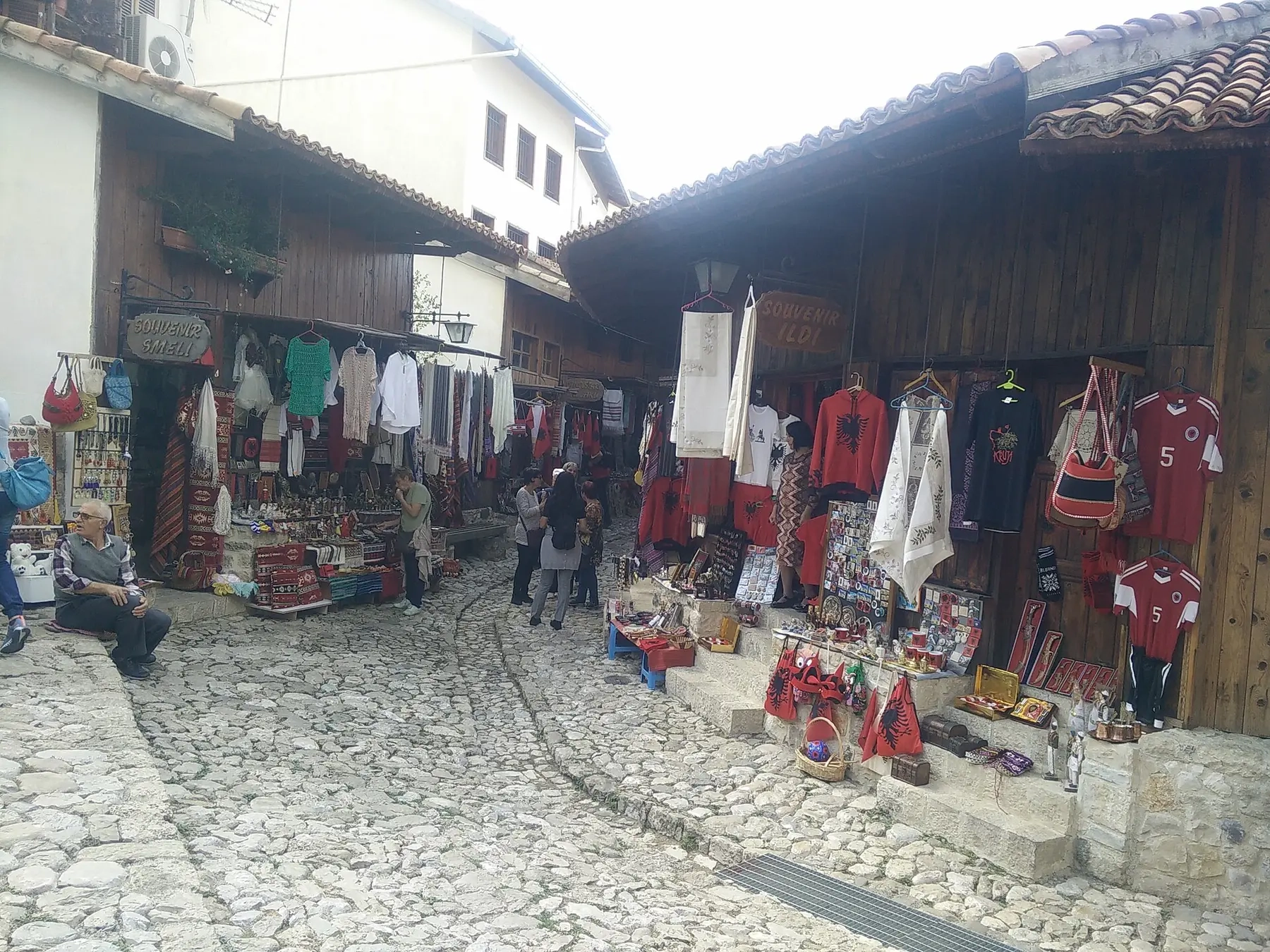
In Kruja, the municipality's culture page says the bazaar was known for working copper, wool and silver and for making qeleshe. A 2017 report by the Albanian Center for Quality Journalism describes Ndriçim Guni as the only artisan in the bazaar making traditional caps and quotes him saying that a cap made abroad is cheaper than the one he makes. Luka Esenko's 2024 account describes Guni's workshop in the Old Bazaar, where he and his son make caps and slippers by hand, and says Guni inherited the craft and the workshop from his father. A second 2024 account, published by the International Feltmakers Association, describes a maker of caps and slippers in Kruja whose father, Ndricim, runs souvenir shops in the bazaar. According to our guides, Ndriçim Guni continues his family's five-generation tradition of making qeleshe. All three accounts mention competition from cheaper caps made abroad.
Seeing it made in Kruja
The Old Bazaar is the cobbled lane that climbs to the castle gate, about 30 minutes by car from Tirana Airport. The box at the top of this page lists the two guided tours that include it and the WhatsApp enquiry for a workshop visit. A visit is arranged on request and is not a listed tour, and a particular maker may not be in on your day.
One 2024 visitor reports signs in the shop saying no photos or video, and the maker telling him photos were fine. Ask before you photograph. If you want to buy a cap, ask who made it and where, since the sources above describe imported caps competing with local ones.
For the dress the cap belongs to, the Ethnographic Museum inside the castle lists folk costumes among its roughly 1,000 objects, according to the Albanian Tourism Agency. Its fee is covered in our castle tickets and hours guide.
See the bazaar with a guide first
The Kruje Castle, Old Bazaar & Hidden Paths Tour starts with a walk down to the Old Bazaar and then goes up to the castle. The guided part takes about 1h 15min – 2h 45min and costs €20 per person, with a maximum of 8 people. Guided in English, Italian or French. A qeleshe workshop visit is arranged separately, on request.
Keep reading
For the lane itself, see the Old Bazaar page. The wider story is in why Kruja matters in Albanian history, and museum fees and hours are in the castle tickets and hours guide. To plan the day, see one day in Kruja or browse all tours. For an evening with live folk music, see the folk dinner guide; for a team visit to the bazaar crafts, business and group excursions.
Qeleshe and plis: common questions
What is a qeleshe?
A qeleshe is a white, brimless cap made from a single piece of wool felt and shaped on a wooden mould. It belongs to traditional Albanian highland dress and is called plis in Kosovo. Its height varies by region: tall in central Albania, flat in parts of the north, round in the rest of the north and Kosovo.
Is a qeleshe the same as a plis?
Yes, they are two names for the same cap. According to Prishtina Insight's 2016 article, qeleshe is the usual word in Albania and plis the usual word in Kosovo. Wikipedia also lists qylaf. Qeleshe comes from lesh, the Albanian word for wool, while plis may be related to Greek pilos, "felt", an etymology that is disputed.
Is the qeleshe really Illyrian?
Several authors say the cap descends from Iron Age Illyrian headwear, pointing to caps in Illyrian graves and to a monument from Zenica in Bosnia that shows a similar cap. The evidence is likeness of shape, and none of the sources we read documents an unbroken line to today, so it is best called the view of those authors. The dated references to the Albanian cap that Wikipedia's article lists begin in 1542.
How is a qeleshe made?
By hand, through felting. Wool is washed, loosened with a bow and wooden hammer, formed into a sheet, soaked in soap and water and worked until the fibres lock together, then shaped on a wooden mould and dried. Accounts of a workshop in Kruja's Old Bazaar describe the felt resting overnight, and Wikipedia adds smoothing with a razor and a rub with a wooden tool.
Is the wool treated with sulfur?
Our guides say makers use a traditional sulfur treatment that keeps the wool from yellowing. We found no published description of that step for the qeleshe. Textile sources document sulfur dioxide as a bleach for wool, and the 1911 Encyclopaedia Britannica notes that the natural yellow can return when the wool is washed with soap or soda.
Is the qeleshe protected as heritage?
The news agency ATA reported on 28 February 2026 that Albania's National Council of Intangible Cultural Heritage had recognised the craft of making the qeleshe as a national value of intangible cultural heritage. In May 2026 Balkanweb reported that the plis is among the elements proposed for UNESCO's list of heritage in need of urgent safeguarding, in a package of files led by the culture ministry. The decision belongs to UNESCO.
Can I see a qeleshe being made in Kruja?
Published accounts from 2017 and 2024 describe a family workshop in the Old Bazaar run by Ndriçim Guni. A visit is not a listed tour. We can arrange one on request: tell us your dates and group size and we reply within 24 hours. We cannot promise that a particular maker will be in the workshop on your day.